The
Statistics
 Please wait for the pictures to load |
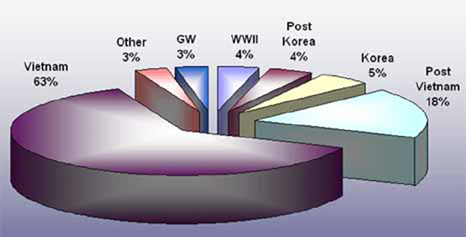
Veterans who served in
Vietnam accounted for more than 60% of all
positive test results. More than half of
all liver transplant patients within the Veterans Health Administration are
the result of the
hepatitis C virus (HCV). Millions of veterans from all wars were
infected and most do not know it.[14]
Veterans will not get tested because they don't think they were exposed to risk factors stated by the Veterans Affairs
Department and the Centers for Disease Control (CDC).
The factors for HCV transmission listed by both agencies,
predominately focus
on drugs, drug paraphernalia, sexually activities and alcohol as screening tools to
test patients.
These Agencies fail to mention, no universal precautions
for medical personnel were in place until
1996. Prior to that, it was common practice
for medical personnel to
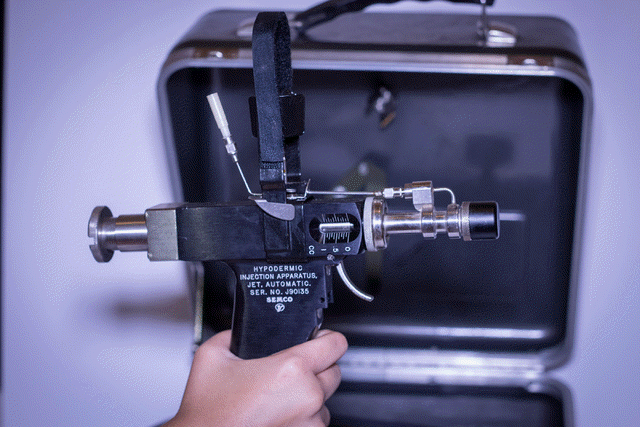
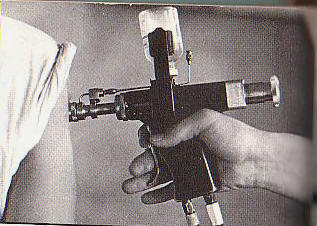
reuse devices such as the jetguns, needles and vials that held the vaccine.
|
|
The use
of mass inoculations can not be overlooked
within this past half century. First the
Military used glass syringe needles,
switching to stainless steel, Both types
were reused and could not be sterilized
because products did not exist that would
kill the virus.
[13] . In
compliance, most health
care providers
did not
wear gloves during dental and medial
procedures.
Korea and
Vietnam Veterans also reflect the improved
"medical delivery capabilities", for
providing medical attention. Much needed
blood for wounded soldiers were delivered as
quickly as possible. Experimental Vaccines,
like the Meningitis and Hepatitis B,
containing human blood bi-products, became
routine. .[15]
Military
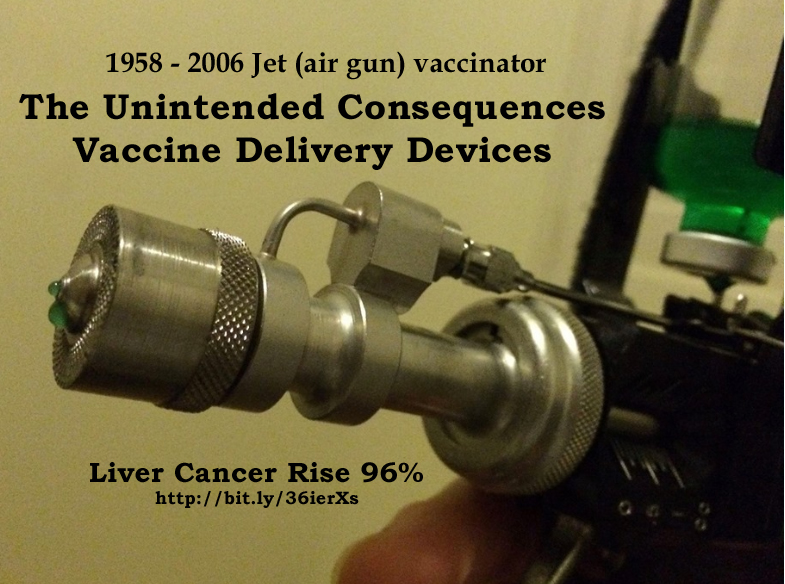
and dependents were also vaccinated with pneumatic air guns (jet
guns), proven to spread hepatitis [3].
They also
received the small pox vaccine administered
with the special needle, used over and
over again, along with the vial that
contained the vaccine.[16] Veterans shared, among themselves,
friends and
family members, grooming items like toothbrushes, manicure
sets, razors and other personal devices that
carry the possibility to retain blood.
Many Veterans donated blood after returning
home and felt it was their duty to do so.

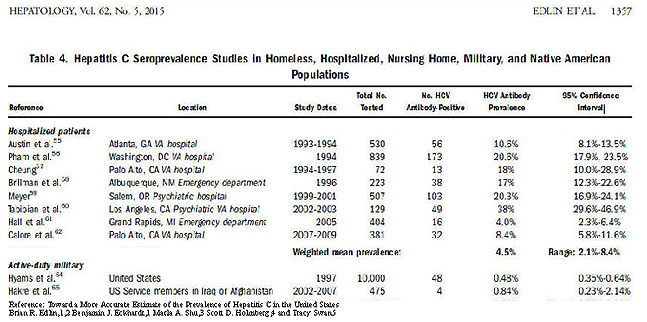
Prevalence of Hepatitis C Among
Military Retirees and Veterans.
1997
Did Shots Cause Hepatitis C? Officials Downplay
Concerns
(Star Tribune)
"Former
Surgeon General C. Everett Koop said more
research is needed on all possible transmission
routes for hepatitis C - including immune
globulin inoculations."
http://www.hcvets.com/data/transmission_methods/published_articles/did_shots_cause_hepatitis_c.htm
1998 HEPATITIS
C: SILENT EPIDEMIC,
MUTE PUBLIC HEALTH RESPONSE
SEVENTH REPORT
by the COMMITTEE ON GOVERNMENT REFORM AND
OVERSIGHT
|
Click here to read the report.
"Former Surgeon General C. Everett Koop
also called for an HCV screening
program for all U.S. military personnel.
In the report
May 1997 VA researcher Dr. Gary Roselle
published the first large study of HCV
infection in VA patients in November
1997. In a mandatory survey of VA
health care facilities, the number of
HCV antibody positive patients
increased as follows:
6,612 in 1991
8,365 in 1992
14,097 in 1993
18,854 in 1994 (the last year with
published data).
He concluded, ``This represents an
increase of more than 285% during
the 4 year period.''\31\ \31\
....Since most veterans are not treated
in VA medical facilities, the
actual incidence of HCV infected
veterans is undoubtedly much greater.
VA has not conducted widespread
surveillance to ascertain the number of
infected veterans.
''\32\ \32\Ibid.
Senator Richard Shelby (R AL)
asked the Pentagon to look further into
the possibility that immune globulins
may have spread HCV. The Pentagon
did not agree to study the issue and
Senator Shelby inserted the following
report language in the 1998
Department of Defense Appropriations
bill: ``The Department of Defense shall
determine rates of hepatitis C infection
among personnel who served in
deployments overseas or who received
blood plasma products from individuals
infected with hepatitis C and provide
counseling and access to treatment for
personnel as needed.''\33\ 
As ordered by Congress
Click here to
read complete report
Results of DoD Investigations
Excerpt-
Hepatitis C Virus Infection Among U.S.
Military Personnel: An Assessment Of
Risks and Screening Strategies
Office of the Assistant
Secretary of Defense --
Health Affairs, the Pentagon;
Washington, DC
April 5, 1999
Serological Survey
-
Vietnam era
personnel: 1000 personnel
currently on active duty who had
been serving in the military
since January 1, 1974.
(Note: This is the end of the
Vietnam era, and right after the
military stopped administering the
reusable small pox needle and small
pox vacation by Jetgun)
-
Active duty retirees
with at least 20 years of military
service: 2000 individuals.
(Note: at least = 1980)
Note: . Rather than determining
rates of hepatitis C infection among
personnel who "served"
in deployments overseas or who received
blood plasma products as ordered by
Congress, the 1999 Senate
Armed Services Committee directed
DoD to
study the
extent of service-connected
hepatitis
C
infection...during separation and
retirement physicals of active duty. The
Vietnam Era is considered to have begun
in 1964 and ended in 1975. But the veterans, that served during the Vietnam
era from 1964 until 1974, were basically
excluded from these results. Nobody
tested the immune globulin, the
ingredient used in many different
vaccines.
In 1999 it was
determined by scientists, the process to
make immune globulin was inefficient at
preventing the transmission of blood
borne pathogens.
Safety
and availability of immunoglobulin
replacement therapy in relation to
potentially transmissable agents
Clinical
& Experimental Immunology
Volume 118 Issue s1
Page 29 - October 1999...
However, the role of partitioning of
viruses cannot be taken in isolation;
when antibodies to HCV were removed
following the introduction of screening,
the amount of recoverable HCV-RNA in the
various Cohn fractions changed
dramatically as a result of the virus no
longer being complexed with antibody.
28
...As Cohn–Oncley fractionation is not
sufficient to remove lipid-coated
viruses, additional antiviral
inactivation steps are required. 
STATEMENT OF TERESA L.
WRIGHT, MD -CHIEF,
GASTROENTEROLOGY SECTION, SAN FRANCISCO
VETERANS ADMINISTRATION MEDICAL CENTER-
BEFORE THE HOUSE VETERANS' AFFAIRS
COMMITTEE SUBCOMMITTEE ON BENEFITS
July 16, 1998- Dr. Wright states;
"From our own experience at the San
Francisco VA Medical Center, HCV disease
is a common problem...10 per cent of
hospitalized veterans were seropositive
for HCV. This is substantially lower
however than the experience at San
Francisco General hospital where the
seroprevalence is 30 per cent...These
questions are being addressed in a
study which is just getting underway
at our VA and which is funded for the
coming five years."

April 13, 2000
Testimony
of
Gary A. Roselle, M. D. - 81% of all Military attending VA clinics and
positive for Hepatitis C are from
the Vietnam and Post Vietnam Era.

Five years later-
VA Study 488- Elevated
Prevalence of Hepatitis C Infection in
Users of United States Veterans Medical
Centers-In summary, we estimate that
5.4% of VA users are HCV-seropositive,
exceeding ...the general population by
more than 2-fold. Although Vietnam
veterans had the highest prevalence
(11%) in our sample,
military-related exposures were not
found to be significant risk factors.
That this
estimate differs considerably
from some prior estimates used to
determine health policy...
How the VA Used Study 488 to Deny
Millions of Retired Military and
Veterans Help.
The
study 488 is used for the bases of a
questionnaire that decides the need
to test Retired Military and
Veterans for Hepatitis C. The study
results show 7% of Veterans
attending VA clinics, reported
having Hepatitis C and receiving a
Jetgun injection during service.
However, some clinics didn't get the
right survey. The wrong survey data
did not included the Jetgun option.
Both, the wrong and
new surveys, did address the
lifestyle risk involving multiple
partners. Jason A. Dominitz, et al,
reports 5.5% association to
infection, if the patient had
between 2 and 49 partners.
Ironically, this risk is listed to
determine the need to test Vets, but
the Jetguns, with a higher
occurrence rate, are not.
Study 488 IS flawed
and diminishes the
real need to test all Retired
Military and Veterans
http://hcvets.com/data/transmission_methods/study488.htm
|

|
|
The Hepatitis
C Endemic
VHA Unique Persons positive for Hepatitis C Antibody
Percent by Era of Service
FY 1998-1999

Click to enlarge |
The Veterans Administration statistics
for 2004 state,
25,470,700 veterans are
alive in the United States and the HCV infection rate among veterans in
the VA system is
about 10% . This means, based on reported numbers of infected people by the
CDC, 3,900,000.
[4] an estimated
11
3/4% of the general population are veterans, or 458,250
veterans were included in the CDC results.
Based on the infection rate quoted by the VA and CDC:
3,441,750
civilians of which 2,547,070 are Veterans, compromise the majority of
infected people in the United States.
Approximately 75%
of the estimated people with
HCV are Veterans with infections longer than 20 years.
Out of the estimated three million chronically infected stated by
the National Institutes of Health (NIH), an estimated 2,250,000 had
this disease for over 20 years. A projected 30%,
or 675,000 veterans, are expected to
develop cirrhosis. Greater than
120,000 are expected to develop cancer
NOW..
[5]
|

VA verses Private Health
Care Standards to Qualify for Treatment Protocol Compound these statistics by a new
study that shows Veterans attending VA clinics do not receive
appropriate testing, care and therapy;
[6] The study
shows the number of patients who benefit from treatment is less than 12%,
while non-VA clinics boast clear rates as high as 40% for the toughest
strain of the virus.
Veterans are also denied treatment, or it is made unavailable because of
medical problems treated for in non-VA clinics.
Pressure must be brought on our government to give all
past and present military personnel, the respect they deserve. Such respect means providing, the paid
for, proper care of our Veterans and their families, as promised, without
delay. Hepatitis C must be made a presumed service
connected disease because military services posed
the most risk for transmission and most people with this
disease have a military background.
Preconceived ideas
and notions have stifled awareness to the many transmission methods,
discovered yearly for this disease; the most recent, GYN spectrums used
for gynecological exams. [11] [12]
How can you Help? File a claim!

The Acknowledgement
P lan Backfires-
VBA Fast Letter Boost Claims
The letter works to the Veterans advantage
because it acknowledges possible ways for transmitting the virus
previously denied by the VA claims adjusters.
Claims that are pending or previously denied, should consider this as
critical evidence to include.
Hepatitis C is a result of receiving immunizations in
service by means of a multi-use jet gun
injector. CONCLUSION OF LAW Hepatitis C was incurred in service. 38 U.S.C.A. §
1131 (West 2002); 38 C.F.R. § 3.102, 3.303 (2005).
ADD TO YOUR CLAIM! 
|
Alert
The VA wants proof Jetgun
injections were used during boot camp, epically Korean war claims. HCVets
has a collection of pictures from many different branches of service.
Please add your pictures of jet injections from camp year books. Email
to HCVets@aol.com
We're also collecting pictures of any mass vaccinations with reused
needles/vials and picture of medical/dental personal not wearing gloves
to help those needing evidence.
View Boot Camp Pictures Submitted
|
|

Veteran's Alert Flyer
Please print and distribute
A Call to Action
Hepatitis C Epidemic
Act, HR 2552
Don't let Hep C get
lost in the mix of
CDC's "EASY FIX"
solutions for real
pandemics.
Please read the
intentions of the
Centers for Disease
Control (CDC) to
stop General
Awareness Campaigns
at state levels
Make Public Health
"DO ITS JOB" as two
Surgeon Generals
have asked!
Address the general
public through an
unbiased
"General Awareness
Campaigns"
Help us really stop
the spread of
Hepatitis C
Read more:
Stop the Hepatitis C
Epidemic Act HR2552
|
|

References
|
[1] Testimony of Gary A.
Roselle, M. D. Program Director for Infectious Diseases Veterans Health
Administration Department of Veterans Affairs Before the Subcommittee on
Benefits Committee on Veterans’ Affairs U.S. House of Representatives
April 13, 2000
http://hcvets.com/data/va_news/testimony_of_gary_a.htm
One in 10 Vets have Hepatitis C -A study
conducted by the VHA, and involving 26,000
veterans, shows that eight to 10 percent of all
veterans in the VHA system tested positive for
hepatitis C. In this study, veterans who served
in Vietnam accounted for more than 60 percent of
those with positive test results.
http://hcvets.com/data/va_news/alf1in10.htm
Hepatitis C:
Silent Epidemic, Mute Public Health Response
Seventh Report By The Committee On Government
Reform And Oversight
http://hcvets.com/data/va_news/testimonyMuteResponse.htm
From our own experience at the San Francisco VA Medical Center, HCV
disease is a common problem....10 per cent of hospitalized
veterans were
seropositive for HCV. This is substantially lower...San Francisco General hospital where the seroprevalence
is 30 per cent
http://hcvets.com/data/va_news/statementTeresaWright.htm
[2]
The Consumers Union Report on Licit and Illicit Drugs
by Edward M. Brecher and the Editors of Consumer Reports Magazine, 1972
some 90 to 95 percent of all GI users sniffed ("snorted") the drug or
inserted a little in a cigarette and smoked it.
http://hcvets.com/news_letter/drugusenam.htm
Recreational Drug Information Website
relatively few were either dysfunctional or addicted users after
their return to the
United States
(58) http://www.drugtext.org/reports/fada/fada1.htm
Hepatitis C in Vietnam Era Veterans Bradford Waters, M.D. Staff
Hepatologist, Memphis VA Medical Center, Associate Professor of Medicine,
University of Tennessee, Memphis 90-95% of addicts smoked heroin and
only 5-10% of that group injected
http://hcvets.com/data/hepatitis_c_in_vietnam_era_veter.htm
[3] HCVets.com Transmission Methods for HCV
http://hcvets.com/data/transmission_methods/transmission.htm
[4] CDC Fact Sheet = Reported
numbers of infected people by the CDC, 3,900,000,
http://www.cdc.gov/ncidod/diseases/hepatitis/c/fact.htm
[5]
NIH Consensus Statements Management of
Hepatitis C: 2002 June 10-12, 2002 Vol. 19, No. 1 FINAL STATEMENT August
27,2002 HCV is the most common chronic blood-borne infection develop
cirrhosis 20 years after initial infection as high as 20 to 30 percent in
middle-aged subjects
http://consensus.nih.gov/cons/116/116cdc_intro.htm
National Institute of Diabetes and Digestive and Kidney Disease Twenty
percent of patients develop cirrhosis within 10 to 20 years of the onset
of infection Liver failure from chronic hepatitis C is one of the most
common reasons for liver transplants in the United States. Hepatitis C
is the cause of about half of cases of primary liver cancer in the
developed world.
http://www.niddk.nih.gov/health/digest/pubs/chrnhepc/chrnhepc.htm
(K70,K73–K74)
National Vital Statistics Vol 49 No 11 Deaths: Leading Causes for 1999- by
Robert N. Anderson, Ph.D. Division of Vital Statistics Table 1 page 15
all races and both sexes, ages 25–34 years is the tenth leading causes of
death. For age 45–54, the sixth leading cause of death
http://www.cdc.gov/nchs/data/nvsr/nvsr49/nvsr49_11.pdf
[6]
VA Study A comparison of hepatitis C
treatment and outcomes at academic, private and Veterans' Affairs
treatment centres D. M. Jensen*,
S. J. Cotler*,
H. Lam ,
G. Harb
& A. Shillington§ .... End-of-treatment
viral response for Veterans' Affairs centers, 17.2%
http://hcvets.com/data/hcv_liver/va_clear_rate.htm
[7]
Veterans'
Health Care: Observations on VA's Assessment of Hepatitis C Budgeting and Funding (25-APR-01, GAO-01-661T).
http://frwebgate.access.gpo.gov/cgi-bin/useftp.cgi?IPaddress=162.140.64.21&filename=d01661t.txt&directory=/diskb/wais/data/gao
[8]
CDC states no association with military service
http://www.cdc.gov/ncidod/diseases/hepatitis/c_training/edu/1/epidem-trans-1.htm
[9]
Drug paraphernalia attributes to about 60% of HCV
transmission
http://www.cdc.gov/ncidod/diseases/hepatitis/c_training/edu/1/epidem-trans-9.htm |
[10]
Needle and syringe exchange and educational programs shown
to be effective in preventing HIV are also useful for decreasing HCV
transmission. http://webmd.lycos.com/content/article/1678.50912
Sniffing, Snorting Drugs May Raise Hepatitis C Risk "The study suggests
that sniffing or snorting heroin with cocaine is a risk factor for HCV
infection," lead author Dr. Beryl A. Koblin of the New York Blood Center
http://hcvets.com/data/transmission_methods/sniffing.htm
National Institute of Cholera and Enteric Diseases, Post Bag 33, CIT Road
Scheme XM, Kolkata 700010, India (e-mail:kamal412496@yahoo.com)
"this continuous increase in HCV infection among IDUs, despite the
needle and syringe exchange programme, is a cause for concern. The cause
of this striking increase in HCV infection is unclear."
http://hcvets.com/transmission_methods/druguseincreasehcvhiv.htm
[11]
Ford Hospital warns patients about
hepatitis Testing instruments possibly contaminated
June 25, 2002 BY PATRICIA ANSTETT AND HUYI JIN ELIZABETH KIM FREE PRESS
MEDICAL WRITERS Olympus America can be reached at 631-844-5688,
www.olympus.com.
Contact
PATRICIA ANSTETT at 313-222-5021 or
anstett@freepress.com.
Contact HUYI JIN ELIZABETH KIM at 313-223-4439 or
kim@freepress.com.
http://hcvets.com/data/transmission_methods/sporadic_transmission.htm
100 women at risk after GP blunder by Camillo Fracassini and Sue
Leonard UP TO 100 women have been put at risk of contracting HIV and hepatitis
after they were given cervical smear tests using unsterilized equipment.
http://hcvets.com/facts_documentation.htm#100 women
[12]
Non-Drug related transmission of Hepatitis C
Excerpt
from Documented USA Media Reports,
Scientific Journals and Government
Agencies on Non-Drug Related
Transmission of Hepatitis C Virus 2003-2005
[13]
Sterilants and Disinfectants
Hepatitis C Survives Treatment with
Commercial Sterilants and Disinfectants
14.
Arthur Caplan, Ph.D. the Chairman of the
Advisory Committee on Blood Safety and
Availability states "The main reason for the drastic
increase in severe hepatitis C-related
liver disease--that means leading to
transplant, leading to death--is that 90
percent of people with chronic hepatitis
C don't know they have it."
http://www.hhs.gov/bloodsafety/transcripts/nov24_98.html
Because most persons with chronic HCV
infection have yet to be diagnosed
http://consensus.nih.gov/cons/116/091202116cdc_statement.htm
15
However,
since 1984, when 64% of the men who got
the vaccine already had full-blown AIDS,
no additional reports have been released
(Waves Forest, "Designer Diseases", Open
Road, Fall 1988, p.3).
http://hcvets.com/data/transmission_methods/aids_history_and_censored.htm
Subcutaneous injections of a drug
containing human immunoglobulins Infect
Dis 1977 Feb;135(2):252-8 Petrilli FL,
Crovari P, De Flora Since late 1974 and
early 1975, several cases of viral
hepatitis were reported in Italy among
subjects who had received subcutaneous
injections of a drug containing human
immunoglobulins
Transfusion 1992 Nov-Dec;32(9):824-8 Recovery
of hepatitis B antibody from human plasma products separated by a modified Cohn
fractionation. Vox Sang 1974;27(4):302-9Berg JV, Berntsen KO, Bjorling H,
Holmstrom B, Vyas GN PMID: 4213354, UI: 75014376
16 2002 CDC Sterilization Rules For
Reusing Bifurcated Needles From
Patricia Doyle, PhD
dr_p_doyle@hotmail.com 12-17-2
http://hcvets.com/data/transmission_methods/smallpox_vaccine.htm
|

HCVets helped stop the use of "old style
jetguns" and made sure the new jetguns do not transmit blood!
FDA
General Hospital & Personal Use Devices Advisory
Panel Presentation
Military application
of jet injection in relationship to the
transmission of bloodborne viruses.
Produced by: HCVets.com
Narrated by: Harry Hooks,
Vietnam Combat Veteran
Click Here to
view the
presentation.
RESULTS: "We Won" by a
4 to 3 vote, jetguns
will be safe
from now on:)
In addition,
discussed
between the World
Health and the FDA
panel, the statement
that more than 10pl of blood
is needed to transmit
Hepatitis C is a bogus
idea.
10 pl of blood
can transmit
Hepatitis C.
|
|
|